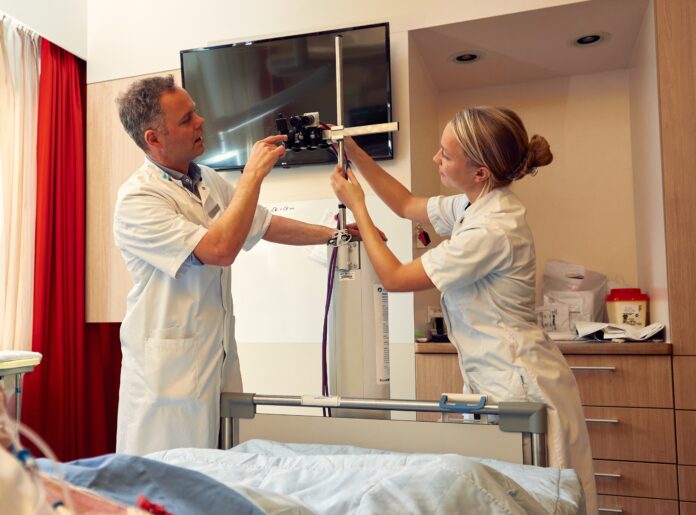
The Catharina Hospital, Philips, and the Eindhoven University of Technology have begun implementing a breakthrough in cardiac care: monitoring vital signs using cameras. The research project, known as Advance ForSee, uses advanced camera technology combined with artificial intelligence (AI) to more accurately predict the recovery of heart patients.
A camera equipped with specialised software monitors patients in their beds to record vital functions. Researchers aim to recognise physical decline faster and better predict a complication-free recovery after surgery. This proactive approach could potentially shorten hospital stays.
Algorithm analysis
“This is the next step in healthcare innovation,” says Gijs van Steenbergen, a researcher and cardiologist in training. “We are developing an algorithm that continuously analyses camera images to predict when risks arise. In heart surgery, this can make the difference in preventing complications and promoting recovery.”
The Advance ForSee study builds on earlier research showing that heart rate and breathing frequency can be reliably measured with cameras while maintaining patient privacy. The algorithm analyses images only at a pixel level, ensuring patients remain unrecognisable. This new study will refine the technology and deploy it directly within heart wards at Catharina Hospital.
By continuously measuring vital signs without staff intervention, the system creates more space for direct patient care. The cameras record signals which the AI then uses to identify patterns and trends. These trends can indicate either a risk of complications or a steady recovery. Detecting a decline early allows doctors to start treatment sooner, helping patients return home safely and more quickly.
“We want the system not just to measure what is happening now, but to predict what might happen,” says Van Steenbergen. “This gives doctors and nursing staff a powerful tool to intervene earlier and make better decisions about discharge times.” Eventually, the system will identify which patients need intensive monitoring and which are recovering well.
Privacy
Privacy is a key consideration in the project. Images are not stored and are completely anonymised. “The cameras only register the parts of the body needed to measure vital signs,” Van Steenbergen explains. “It never involves recognisable faces or identifiable features.” Additionally, patient rooms are fitted with a privacy hatch that allows patients to temporarily stop monitoring.
The project is a collaboration within the (e/MTIC) partnership, supported by a grant from (ZonMW). Mark van Gastel, an algorithm development lead at Philips, notes that clinical validation is essential for such innovations. He believes this cooperation enables technology to be integrated into the clinical workflow in a responsible, evidence-based way.
NEWS BRAINPORT