The long-awaited direct intercity connection between Eindhoven and Düsseldorf has faced a major setback, with completion now pushed back to at least 2030. State Secretary for Infrastructure Thierry Aartsen officially informed the Dutch House of Representatives of the delay this week, describing the situation as “deeply regrettable” for both international travellers and the regional economy.
Plans for the direct service, which would extend the (RE13 Maas-Wupper-Express) to Eindhoven, have been in development since 2018. While the most recent target was December 2026, a combination of infrastructure bottlenecks and rolling stock shortages has made this date impossible to meet.
The Venlo bottleneck
The primary cause for the delay lies at Venlo station, a critical but “complex” border node. According to Aartsen, the station is currently handling several overlapping projects simultaneously, leading to significant congestion. ProRail has confirmed that while the track between Eindhoven and Venlo was upgraded on time, the specific infrastructure required at Venlo station to allow trains to switch between the Dutch and German power systems will not be ready for years.
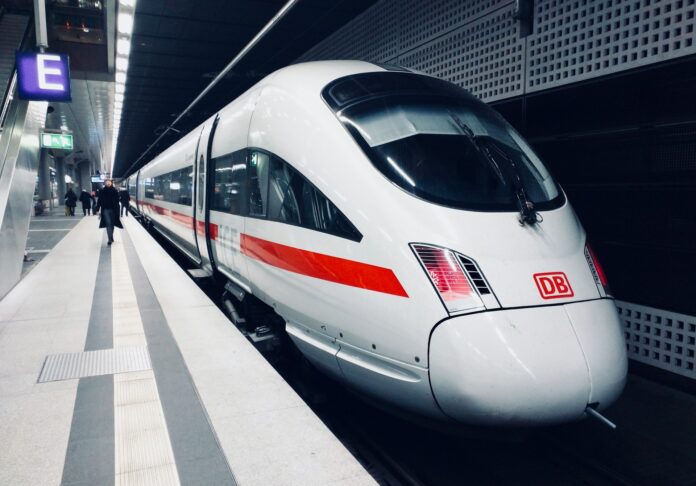
Furthermore, the operator Start—a subsidiary of Deutsche Bahn—is still waiting for twenty new (Flirt 3XL) trains from manufacturer Stadler. These specialised trains are essential because they can operate on both the Dutch 1.5kV and German 15kV electrical systems. Until these trains are delivered and the Venlo station works are completed, a seamless border crossing remains impossible.
A setback to the Brainport economy
The postponement is particularly damaging for the Brainport Eindhoven region, one of Europe’s most powerful innovation hubs. Currently, the journey to Düsseldorf takes nearly two hours and requires a tight transfer in Venlo. By car, the same trip is roughly 30 minutes faster, a disparity that hampers the region’s efforts to move toward sustainable transport.
In his letter to parliament, Aartsen emphasised the importance of the link:
“The Brainport Eindhoven region is one of the most powerful innovation regions in Europe with great economic importance. Good connectivity on a national and international level is therefore of great significance.”
Local officials have long lobbied for the connection, noting that the German Ruhr area is a vital trading partner for Eindhoven’s high-tech sector. The direct link was projected to attract 250,000 additional passengers annually, representing a 40% increase in ridership.
Search for interim solutions
Aartsen urged ProRail to think “out of the box” to find temporary solutions for the interim period starting in late 2026. One proposal under review is to operate a limited-service route between Eindhoven and Venlo using available rolling stock. However, this would not eliminate the need for a transfer.
“Unfortunately, finding a solution is proving to be difficult,” Aartsen noted, warning that any temporary measures would likely not fully meet the demand. For now, the region must wait until at least until 2030 to secure a rail connection that aligns with its global economic ambitions.
NEWS BRAINPORT