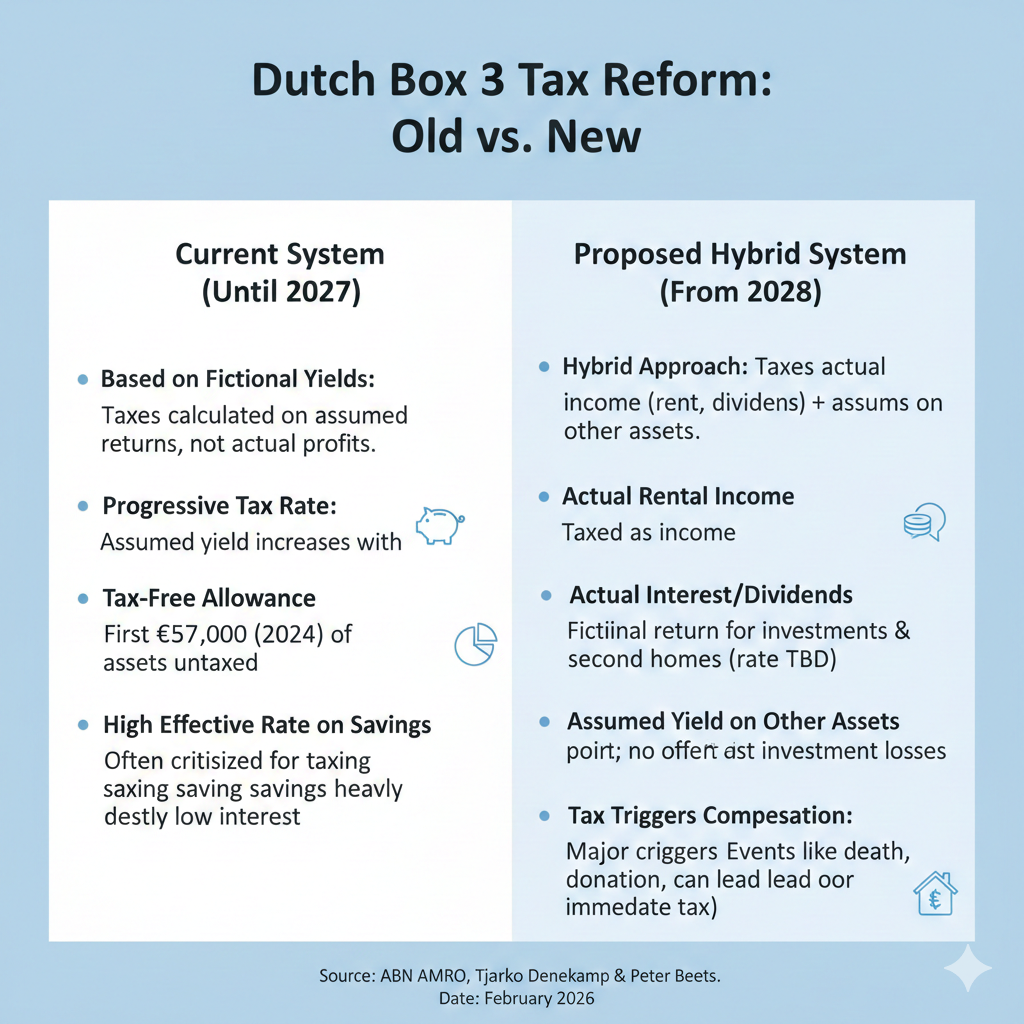
The Dutch government’s proposal for a new Box 3 tax system is legally and practically vulnerable, according to wealth experts Tjarko Denekamp and Peter Beets from ABN AMRO. Box 3 is the system used to tax income from assets such as savings, shares, and second homes. While the current rules are being phased out, experts warn that the new regime’s proposal, scheduled for 2028, risks starting on a negative note.
Politicians have long agreed that Box 3 requires reform, but have struggled to agree on a method. Although many parties are now aligned, experts claim that only a few members of the House of Representatives are enthusiastic about the proposed legislation. They argue that the current hybrid model, which combines capital gains and capital gains taxes, is inferior to a system based entirely on capital gains taxes.
Capital gains tax
Under a capital growth tax, investors pay annually on the income their capital generates, such as interest. A capital gains tax, however, only applies when a profit is actually realised or “cashed in”. While a pure capital gains system was considered, it would result in the government forgoing billions in immediate revenue. Consequently, the hybrid model is more likely to secure a majority.
Lack of loss compensation
A major concern for the experts is the lack of compensation for losses. This could penalise investors whose portfolios decline in value before 2028. If those investments merely recover to their original value after the new law takes effect, the recovery could be taxed as a profit even though the investor has made no real economic gain.
The experts also noted that events such as death, donations, or changes in property ownership could trigger immediate tax bills. This may lead to difficult situations, such as forced sales. Additionally, the proposal includes a property levy that could apply even if the building is vacant or unrentable. To strengthen the system’s credibility, experts are calling for a draft recovery law to address these flaws early.