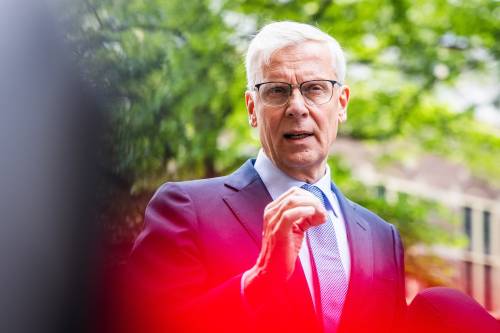
It is sensible that the Dutch cabinet has not yet immediately announced a package of measures to lower energy costs for households. Marrixt van Rij, the Dutch member of the board of the International Monetary Fund (IMF), said this in an interview with ANP. In his view, the cabinet’s choice so far is in line with IMF advice: do not move too quickly.
The war in the Middle East has pushed energy prices up sharply. While several European countries have already introduced measures to ease the burden on their populations, that has not happened in the Netherlands.
But according to Van Rij, it is still too early to reach for policy tools quickly and, in the very short term, perhaps spend a great deal of money. The former CDA politician, who now sits on the IMF board, said the IMF has spoken “quite openly” on this point.
Russion invasion
As State Secretary for Finance, Van Rij was involved in the emergency measures taken by the Rutte IV cabinet in 2022, when inflation rose sharply following Russia’s invasion of Ukraine. Even then, action was needed, he said. According to Van Rij, inflation from the war in Ukraine had already risen considerably by then. It also quickly became clear that households were struggling with their energy bills.
If the cabinet does decide to act, the IMF’s advice is to keep any intervention targeted and temporary. “Focus in particular on income groups that are genuinely getting into difficulty.”
Energy allowance
“The Netherlands does not need to reinvent the wheel,” Van Rij said. In his view, there was already extensive research in 2022 into which measures are effective. He cited the energy allowance for households with an income up to 120 per cent of the social minimum as an example.
“That was when the question also came up: can’t you do anything else?” Van Rij recalled. “Could we not raise healthcare or housing benefit?” But he said that soon becomes quite complicated. “You also have to take proper account of whether it can actually be carried out, for example by the Tax Administration.”
In 2022, the cabinet also decided to cut fuel duty. Van Rij acknowledged that this was not a targeted measure. The aim was to ease high costs temporarily. But the cut has so far only been partly reversed. “That shows you do need to be careful with this kind of measure.”
@anp | NEWS BRAINPORT