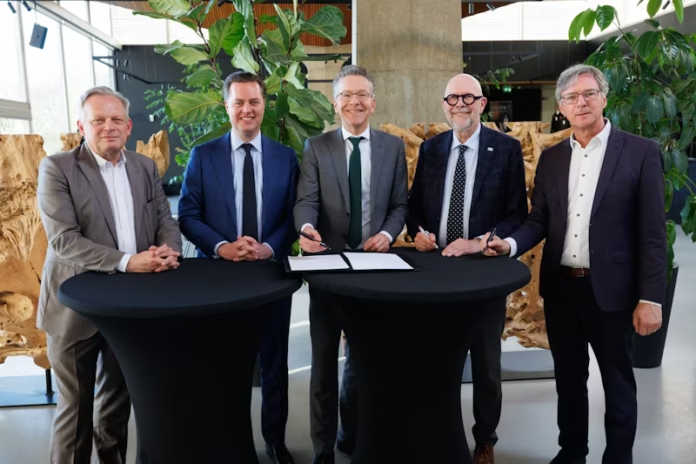
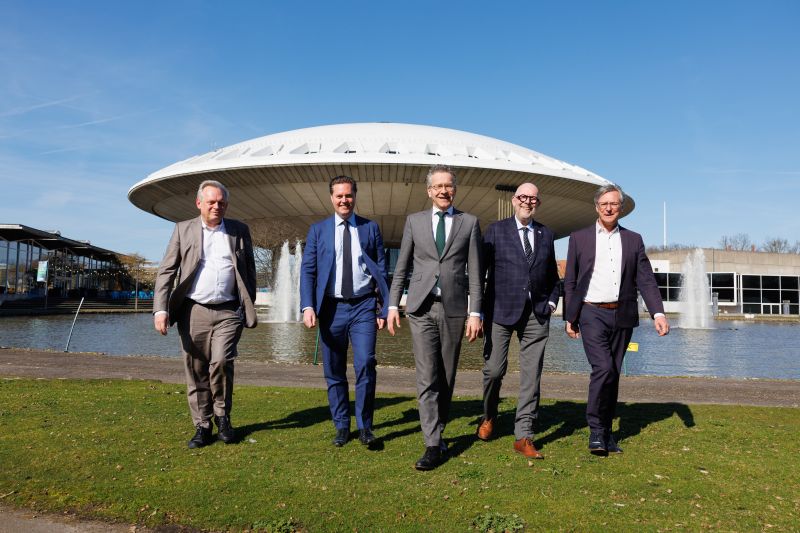
Metropolitan Region Brainport Eindhoven, Belgian Limburg, and the Antwerp Kempen have agreed to deepen their cooperation on innovation, economy, accessibility, and spatial development. A few days ago, the partners signed a cooperation charter designed to bolster their shared economic and spatial interests.
Companies, research institutions, and employees have long operated across these regional borders. The new charter aims to make this existing relationship more structured. By aligning innovation clusters and spatial planning, the regions intend to strengthen the economic standing of the border area while ensuring balanced growth.
The partnership focuses on three primary innovation clusters:
- High Tech: Including high-precision manufacturing for the semiconductor industry, radiation-resistant electronics, and large-scale science projects such as the Einstein Telescope.
- Smart and Clean Mobility: Focusing on opening cross-border testing facilities and accelerating the electrification of freight transport.
- Bio-based Materials and Circular Construction: Promoting circular demolition, the reuse of materials, and the scaling up of bio-based building materials such as natural fibres.
The regions also plan to explore potential cooperation in life sciences, human capital, and artificial intelligence.
A preliminary study highlighted that these areas are already technologically linked. For instance, the Open Manufacturing Campus in Turnhout develops specialised equipment used in the semiconductor industry near Eindhoven. Furthermore, the Flemish regions offer space for business locations, housing, and electricity grid capacity that has become increasingly scarce in the rapidly growing Eindhoven area.
New Public transport connections
The cooperation between Brainport Eindhoven and its Flemish neighbours includes several specific projects to improve connectivity for residents and businesses. A primary focus is the development of new public transport links, such as an express bus between Eindhoven and Turnhout. This fast bus connection is designed to better link the high-tech hub of Eindhoven with the Antwerp Kempen. Additionally, local transport hubs in Valkenswaard and the Belgian municipality of Pelt will be more closely integrated to facilitate easier travel between North Brabant and Belgian Limburg.
Rail infrastructure
Rail infrastructure is also a key priority within the new partnership. There is a renewed push to reactivate the eight-kilometre stretch of track between Hamont and Weert for passenger trains. Currently used only for freight, opening this link would create a direct rail gateway between Antwerp and the southeastern Netherlands. These efforts follow a separate declaration of intent signed in February 2026, which specifically aims to upgrade the rail connection between the Eindhoven tech region and the Belgian capital of Brussels.
Roadways
While fast buses remain the short-term priority, the regions are working with national governments to secure investment for future cross-border rail or tram lines. In the meantime, road and infrastructure alignment remains high on the agenda. This includes efforts to better coordinate the Dutch (N69) between Eindhoven and Valkenswaard and the Belgian (N74) between Hasselt and Pelt to create a safer and more continuous international route.
The partnership also extends to shared testing facilities for the transport sector. By opening “Smart Mobility” test tracks across the border, companies will be able to test electric freight and autonomous vehicles in both countries seamlessly. These infrastructure improvements are intended to support the region’s rapid growth and ensure that the cross-border transport network can keep pace with economic development.
Jeroen Dijsselbloem, Chair of Metropolitan Region Eindhoven and the Brainport Foundation, stated that the region is growing so quickly that it can no longer manage every challenge alone. He noted that it is logical to work with Flemish neighbours on housing and transport, as the growth of Brainport creates pressure that requires cross-border solutions.
The charter establishes a two-year work agenda to identify and launch specific joint projects, with an initial focus on innovation and accessibility.
NEWS BRAINPORT