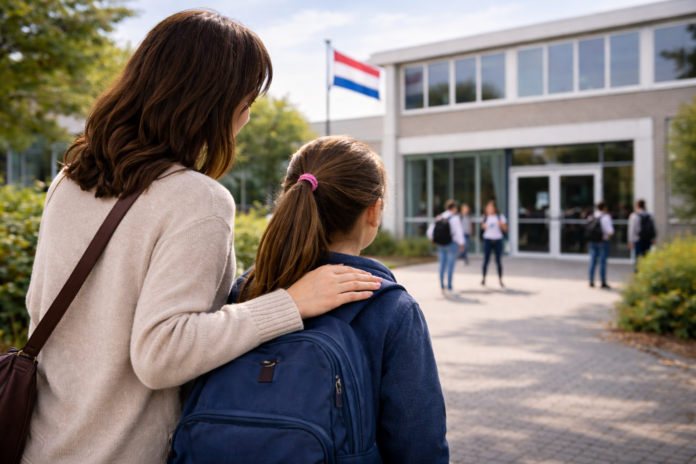
How do you tell a child, “You didn’t get into a school”?
There are 35 families searching for an answer to that question. The secondary school crisis unfolding in Eindhoven, the Netherlands, reveals a much deeper and more striking picture when seen through the eyes of the parents living through it firsthand.
One of the parents I spoke with is Beste Ertürk Sönmez. As she describes her daughter’s transition to secondary school, she is not only telling her own story, but also recounting the moment when people collide with the walls of a system and are shattered by it.
In the Eindhoven-Kempenland region, secondary school applications are handled through a joint system called LDOS.
All secondary schools in the region are part of this system, and each school announces at the beginning of the year how many students it can admit. Until March 31, families rank up to five choices among four schools.
Then the system takes over: using a method called the Boston algorithm, all preferences are matched, and each child is assigned to a school.
In short, schools announce their capacity, families enter their preferences, and the algorithm makes the decision.
In theory, it seems like a fair system. Everyone is subject to the same rules and in the same pool.
But mathematics does not always speak the same language as a society’s conscience. The Boston Algorithm, which has divided academic circles, was deemed “unfair” by Amsterdam and abandoned in 2015.
At the time, the city chose a different path by adopting a more transparent mechanism. What is happening in Eindhoven once again shows us why this technical debate is so vital: an algorithm that appears flawless in theory can become the name of deep uncertainty in the lives of many families.
“Oh, your child was just very unlucky”
The results are announced on April 2. Applications had closed on March 31, and the Sönmez family had listed five preferences among four schools.
While the results were expected to be announced at 3:30 p.m., the phone rang earlier. It was their first-choice school calling.
The sentence was brief:
“Oh, your child was just very unlucky. We’re sorry.”
Sönmez describes that moment like this:
“We were in complete shock. We didn’t even know how to explain it to our child.”
The family goes to their daughter’s school and tries to explain the situation together with her teacher. Because this is not just a placement result; it is one of the first major disappointments in a child’s life.
In the Eindhoven secondary school crisis, even five choices were not enough
It turns out that Sönmez’s daughter was not placed in any of her choices.
That same day, the family is sent a list of schools with available places. They are asked to visit those schools and submit three new preferences by April 14.
But the uncertainty does not end there.
Within Eindhoven, the options are extremely limited: there are only four schools on the list. Moreover, there is still no guaranteed place at any of these schools; families are told that if demand is too high, there may be another lottery.
Sönmez sums up the situation as follows:
“They acted as if this were somehow our fault. They basically said, ‘These are the leftovers.’ No one wants to take responsibility.”
Families are looking for a solution among themselves
Families in similar situations have come together in a WhatsApp group. They are discussing what they can do and trying to support one another. Some are even considering legal action if necessary.
But the main issue they keep returning to is this: no one is sitting down to listen to them as a group.
According to Sönmez, the authorities are willing to accept individual meetings, but no space is being created where families can raise their voices together.
The number of students who were not placed in any school is 35. The majority of this group, around 30 students, are children who received a VWO recommendation.
This picture suggests that the issue is not merely individual, but structural.
The real question
On paper, the system may appear to be functioning. But some children are still waiting for an answer to the question: “Which school will I go to?”
And one question remains:
If a system is built to include everyone, what happens to the children left outside it?
A request for comment has been sent to RSV PVO, and a response is awaited.
This article is based on the account of a parent who personally experienced the process.
Ayşenur Kuran | NEWS BRAINPORT