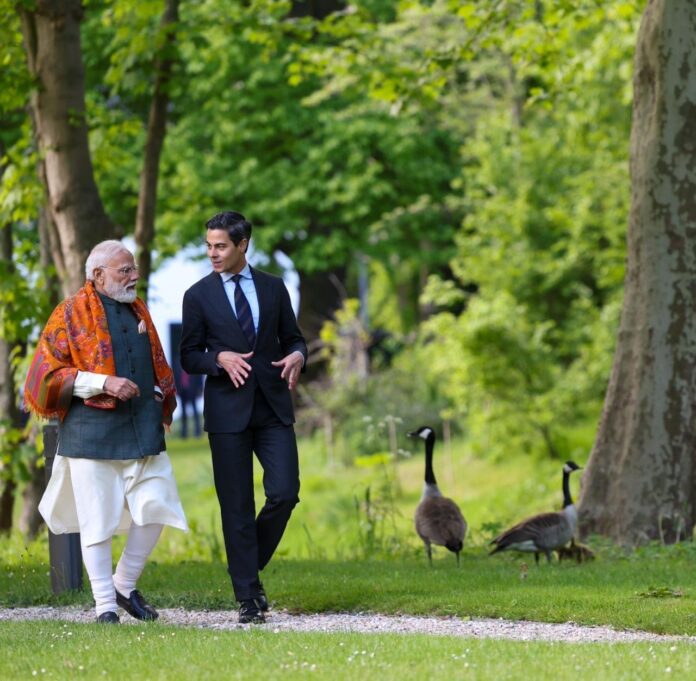
At the invitation of Rob Jetten, the Prime Minister of the Netherlands, Prime Minister Narendra Modi visited the Netherlands on May 15-17, 2026.
Prime Minister Narendra Modi and Dutch Prime Minister Rob Jetten held official bilateral talks followed by a dinner. The two Prime Ministers reflected on the bilateral trade connections and strong interpersonal relationships. They committed to deepening this multifaceted partnership by expanding cooperation across 17 identified areas.
“These are substantive and important outcomes. They add unparalleled momentum to the friendship between India and the Netherlands. These outcomes cover many sectors and will enhance growth and prosperity for our nations.” – Modi
Collaboration in higher education
The leaders discussed a Memorandum of Understanding (MoU) on higher education designed to foster closer cooperation between institutions in both countries.
They also welcomed a new Memorandum of Cooperation between Eindhoven University of Technology, the University of Twente, and six leading Indian technical institutes: IISc Bangalore, IIT Bombay, IIT Delhi, IIT Gandhinagar, IIT Guwahati, and IIT Madras. Supported by industry partners NXP, ASML, TATA, and CG Semi, this partnership specifically aims to catalyse research and development and talent cultivation in the semiconductor sector.
Additionally, the University of Groningen (RUG) and 19 Indian Institutes of Technology (IITs) agreed on an academic collaboration. This includes the creation of a PhD Fellowship Programme on Hydrogen, co-funded by India’s Department of Science and Technology and RUG.
Cooperation in semiconductors and innovation
Both leaders expressed their support for the signing of the Memorandum of Understanding (MoU) on a partnership in Semiconductors and Related Emerging Technology. This agreement focuses on semiconductor investment, research, and talent exchange. Furthermore, the leaders welcomed an initiative to integrate the Dutch Semicon Competence Centre with the Indian Semiconductor Mission (ISM). This move aims to bolster the semiconductor industry by supporting startups, scale-ups, SMEs, and their suppliers. They also voiced their support for continuing the Indo-Dutch Semicon Online School into its next phase.
Restitution of cultural artifacts
As a stellar example of cultural cooperation and respect for heritage, Prime Minister Jetten announced the repatriation of the Chola copper plates from the Netherlands to India.
“A joyous moment for every Indian! Chola copper plates dating back to the 11th Century will be repatriated to India from the Netherlands,” Modi announced.
The artefact comprises 21 large plates and 3 small plates containing ancient Tamil texts. Modi noted that these plates represent the historical greatness, refined culture, and maritime prowess of the Chola Empire. The Indian Prime Minister thanked the Government of the Netherlands and Leiden University for carefully preserving this cultural heritage and facilitating its return to its homeland.
Community engagement
The Indian Embassy in the Netherlands successfully hosted a community meet-up at the World Forum in The Hague, where PM Modi addressed about 2,000 attendees. “The embassy team efficiently organised the event and handled background checks and security clearances seamlessly within just a few weeks’ notice,” remarked an attendee, Venkat.
Cultural exchange
The Prime Ministers recognised the significant connections between their citizens. This is a vital aspect of the India-Netherlands relationship. Prime Minister Jetten expressed appreciation for the valuable role the Indian community plays in Dutch society. Both leaders reiterated their commitment to enhancing interactions among their countries’ citizens. Acknowledging the need to promote fair migration and mobility, both leaders celebrated the signing of an MoU on these issues.
The nations agreed to bolster cooperation aimed at tackling irregular migration and human trafficking. However, they advocate for the equitable movement of skilled professionals. This strategy aligns with international norms that guarantee the respectful and dignified treatment of migrant workers.
The two Prime Ministers concurred on the necessity to strengthen cultural bonds through greater collaboration. Areas such as design, performing arts, visual arts, and museum and heritage partnerships will be a focus. For this, they discussed the potential creation of a Joint Working Group focused on Cultural Cooperation.
Energy transition and circular economy
To enhance collaboration between India and the Netherlands on Renewable Energy, the leaders welcomed the establishment of a Joint Working Group under the Renewable Energy MoU. This initiative presents opportunities for cooperation in solar energy, green hydrogen, and the energy transition. To enhance collaboration and mutual investments in renewable energy, the leaders introduced the ambitious India-Netherlands Roadmap focused on developing Green Hydrogen. This roadmap will bolster India’s aspirations and capabilities regarding the production, use, and export of Green Hydrogen. It will also aid in the faster integration of Green Hydrogen as a sustainable energy source in both nations.
They expressed a mutual interest in strengthening collaboration on supply chain resilience, circularity, and adherence to ESG standards. In this context, they welcomed the signing of an MoU on critical minerals.
NEWS BRAINPORT