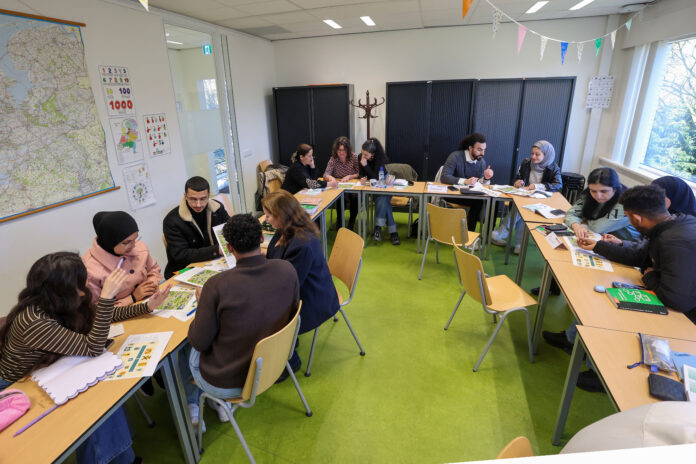
More than 230 asylum seekers in Eindhoven have started a specialised training program designed to prepare them for careers in the semiconductor sector. The initiative begins with intensive language modules focused on industry terminology before moving on to technical training. The project aims to provide a sustainable path to employment within the region’s rapidly expanding microchip industry.
Enabling employment of asylum seekers
The Brainport region expects a shortage of approximately 26,000 employees in the semiconductor and microchip sectors over the coming years. To meet this demand, local government, educational institutions, and businesses are collaborating to tap into every available source of talent, from newcomers to those currently receiving state benefits.
Saskia Lammers, the alderperson for the Southeast Brabant labour market, visited a class at Summa on 5 March to highlight the project’s importance. “Every talent counts; we need everyone,” Lammers said. She emphasised that enabling newcomers to participate in the local economy from their first day is essential. She also noted that the severe staff shortage requires employers to rethink job roles and support structures to accommodate untapped talent.
Curriculum
The curriculum starts with a focus on sector-specific language and jargon, followed by modules on safety, industry orientation, and basic technical skills. Jeroen Wissink, a program manager at Summa, explained that the language and technical components are part of a single, continuous pathway. “We align the modules well to help participants move into semiconductor jobs more successfully,” Wissink said, noting that students attend regularly and stay engaged.
The program currently operates 18 classes across six locations. Participants study language development for three hours a day, four days a week, with technical training set to expand later. An additional 80 participants are expected to join in the coming months, with a goal of enrolling 80 new candidates every quarter. The initiative also plans to expand to other municipalities.
This training is supported by the National Microchip Talent Strengthening Plan. Partners, including the TU/e, Fontys, Summa and the Central Agency for the Reception of Asylum Seekers (COA), Wasbeer & Pauw. By 2030, the collaboration aims to have trained thousands of new workers to strengthen the Brainport region’s position in the global microchip market.
NEWS BRAINPORT