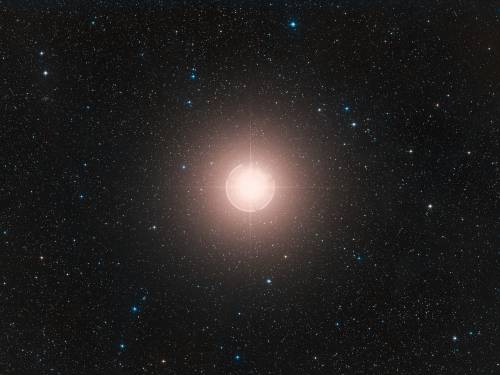
Century-long quest ends with direct imaging
Astronomers found convincing evidence that Betelgeuse is not alone. A research team published an image of a companion star, named Betelgeuse B, in the journal Astronomy & Astrophysics. Lead researcher Miguel Montargès called the discovery the conclusion of a century-long search.
Betelgeuse sits in the Orion constellation and remains visible to the naked eye from Earth. Astronomers have studied the star for many years due to its fluctuating brightness. Scientists suspected an orbiting companion star influenced this light output. However, Betelgeuse’s intense glare previously prevented detection. Earlier models predicted the companion would reach its furthest orbital distance from Earth’s perspective in late 2024.
Chilean telescope captures historic images
Observations confirmed predictions in December 2024. The research team, including Dutch astronomer Alex de Koter, used the Very Large Telescope (VLT) in Chile’s Atacama Desert to capture the sharpest image of Betelgeuse to date.
Montargès expressed surprise at the processed images. He did not expect the VLT to detect the star. However, Betelgeuse B proved heavier and brighter than initial estimates. Researchers originally assumed the companion matched the Sun’s mass. New data indicates Betelgeuse B weighs two to three times more than the Sun.
Dutch instrument proves key to breakthrough
The team imaged Betelgeuse B using a instrument developed partly in the Netherlands. Engineers originally designed the tool to search for exoplanets, but it also identifies faint companion stars.
Montargès remains cautious despite the clear visual evidence. The team plans to observe Betelgeuse B again in one year on the opposite side of the main star to confirm its orbit permanently.
@ anp | NEWSBRAINPORT