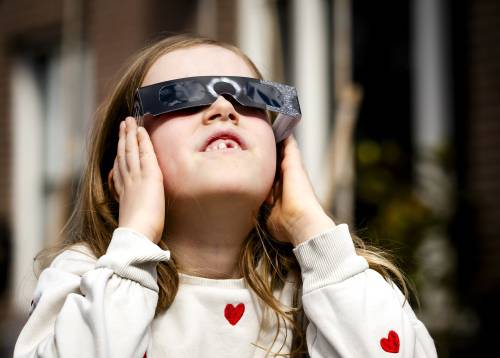
Parents should closely watch young children and teenagers during Wednesday evening’s solar eclipse, according to Alberta Thiadens, ophthalmologist and researcher at Erasmus MC. She warns that young people face a greater risk of eye damage if they look directly at the sun.
“The lenses of their eyes are very clear, so they are at greater risk of damage. Furthermore, the risks of retinal damage are exactly the same for adults,” Thiadens said.
She expects many young people may be tempted to look at the eclipse. “It is the middle of the summer holidays and the solar eclipse takes place at a convenient time, around dinnertime. That creates a greater risk of eye injury.”
The Dutch Ophthalmological Society (NOG) has also urged parents and caregivers to watch curious children carefully and ensure they do not look directly at the sun.
Thiadens explained that when someone looks straight at the sun, the eye focuses sunlight onto the retina, the part of the eye responsible for sharp vision. “Because of the enormous amount of light, damage can occur there. No treatment can cure this retinal damage. You can compare it to a magnifying glass that focuses sunlight onto a single point.”
She added that the danger is difficult to detect immediately. “You do not feel it because there are no pain receptors in the retina. Furthermore, symptoms often only appear hours later.”
According to Thiadens, it is difficult to predict how many people may suffer eye damage during a solar eclipse. The only available data comes from British research following the previous solar eclipse in 1999.
“There were many worried phone calls at the time. Ultimately, seventy people reported symptoms. Extrapolated to the Dutch population, that would mean about eighteen to twenty people with eye damage,” she said.
The study also found that none of the patients had permanent damage after 1.5 years.
@anp | NEWS BRAINPORT