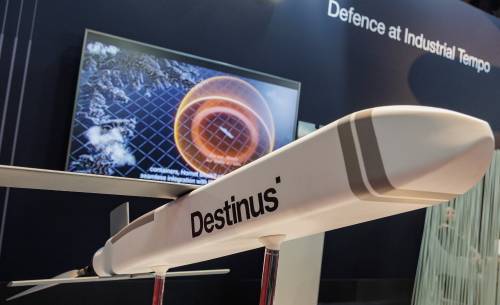
The Dutch rocket and drone manufacturer Destinus is leading an ambitious European consortium to develop a cutting-edge defence system. This new weapon, called ‘Bliksem EXO’, will target and destroy medium- and intermediate-range ballistic missiles while they travel through space.
Four European aerospace and defence giants have partnered with Destinus on the project:
- Thales
- Airbus Defence & Space
- MBDA Deutschland
- Safran Electronics & Defense
The companies will start joint engineering in August 2026. They plan to test the interceptor vehicle in space in 2027.
Stopping Hypersonic Threats in the Void of Space
Ballistic missiles present an extreme challenge for traditional air defence systems. These weapons fly on a high, arched trajectory that takes them completely out of the Earth’s atmosphere. Once in space, they head downward and descend toward their targets at hypersonic speeds. This rapid descent makes them incredibly difficult to track and hit.
Bliksem EXO solves this problem by neutralising the threat early. The interceptor targets the incoming missile in space before it can re-enter the atmosphere.
How “Hit-to-Kill” Technology Works
Standard anti-aircraft missiles explode near a target to shred it with shrapnel. In contrast, the Bliksem EXO relies entirely on kinetic impact technology:
- Direct Collision: The interceptor physically rams into the incoming ballistic missile at extreme speed.
- Kinetic Energy Transfer: The force of this high-speed collision instantly disintegrates both vehicles. No explosive warhead is necessary.
- Debris Control: Intercepting a weapon in space ensures that dangerous debris burns up upon atmospheric re-entry. This process drastically reduces collateral damage on the ground.
Part of a Broader European Defence Strategy
The development of the Bliksem EXO directly supports a new international alliance. Ten European nations, including the Netherlands and Ukraine, recently established the ‘coalition against ballistic missiles’. The coalition aims to deploy advanced defensive shields to protect European airspace from sophisticated long-range threats.
This project marks a major milestone for Destinus. The Dutch firm has transitioned from a high-tech startup into a key player in European defence. By coordinating the expertise of Airbus, Thales, MBDA, and Safran, Destinus hopes to establish a sovereign European shield. This system will help secure European skies for decades to come.
@ anp | NEWS BRAINPORT