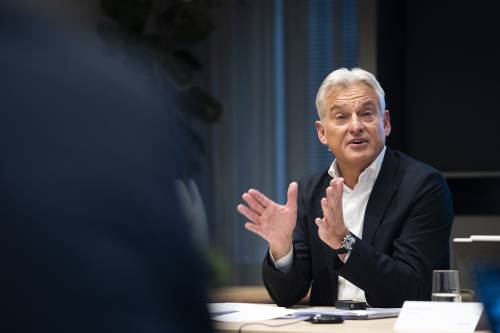
Rabobank CEO Stefaan Decraene has welcomed the Dutch government’s new package of nitrogen measures, saying it finally provides the “contours” of a solution to help resolve the Netherlands’ long-running nitrogen crisis.
According to Decraene, who leads the bank that finances many Dutch farmers, some farmers will be negatively affected by the plans. However, he said inaction would be a worse outcome.
“The bad thing would be: doing nothing. Action is being taken, and we are happy about that,” he said.
Decraene stressed that farmers need certainty to make investment decisions. “Farmers are entrepreneurs and need clarity to make decisions,” the Belgian CEO said. “There are quite a few farmers who want to invest.”
He also pointed to the urgency of the situation, noting that the permitting system has become stuck. “The permitting policy is completely deadlocked.”
The Rabobank chief welcomed the government’s decision to allocate more than €20 billion for the measures. He also expressed support for the area-based approach. “This is a basis for further discussion.”
Protests
In recent weeks, farmers have protested in several parts of the country, blocking roads in opposition to the government’s nitrogen plans.
“There are always a number of farmers who are slightly less happy with that,” Decraene said. He noted that concerns are particularly strong among farmers located near water catchment areas and nature reserves.
However, he believes the measures are necessary. “To return to somewhat more climate-friendly agriculture, and to loosen up the permit policy a bit, I think these measures are the right ones.”
Effect
Decraene said the success of the package will depend on how it is implemented. Rabobank is discussing this with the government.
“It must be legally implementable. It must be workable. And ultimately, there must also be a revenue model for the farmer,” he said.
Rabobank says key questions remain, including how the €20 billion will be spent and how transition arrangements will be designed. Decraene also expects that some details of the plans may still be adjusted.
Major financier
Rabobank has long been one of the largest financiers of the agricultural sector. In that role, the bank helped support the expansion of livestock farming over many years. It has also faced criticism over its role, with some political parties arguing that the bank should contribute to the costs of resolving the nitrogen crisis.
The bank previously made €3 billion available to help farmers transition to more nature-friendly farming methods. Farmers can use these funds to finance investments on favourable terms. According to Decraene, more than €1 billion of that funding remains available and can now also be used by farmers looking to invest.
@anp | NEWS BRAINPORT