AI platforms such as ChatGPT, Gemini, and Claude provide varying political advice when used to complete the StemWijzer, a Dutch voting aid, according to new research focused on municipal politics in Eindhoven.
A study by a local company
The study, conducted by the Eindhoven-based firm Answer.one, analysed how eight generative AI platforms interpreted 30 statements from the voting aid. Researchers generated 14,400 answers across systems, including ChatGPT, Gemini, Perplexity, Google AI Overviews, DeepSeek, Claude, Grok, and Mistral.
When the AI models completed the voting aid, a distinct ranking of political parties emerged. On average across all models, D66 was the highest match, followed by ProEindhoven and CDA. However, individual results varied significantly. For instance, ChatGPT and Grok both placed Ouderen Appèl Eindhoven in first position, while Gemini favoured Blanco 14 (Versantvoort). Mistral, the only European model in the study, placed ChristenUnie at the top.
AI distortions
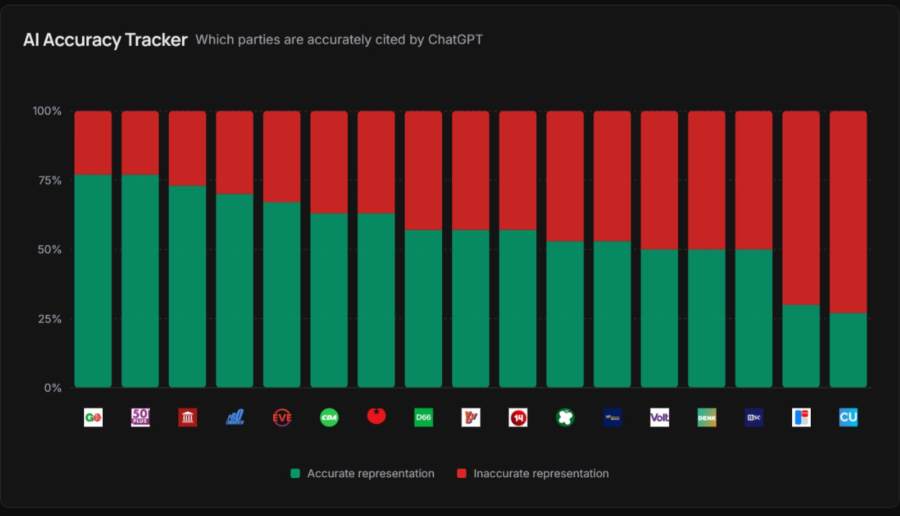
The research also highlighted that AI systems frequently misrepresent party positions. The models identified every party’s stance on each statement and found that only about two-thirds of the information was displayed correctly. While parties like GroenLinks-PvdA and FvD were correctly interpreted 77% of the time, the accuracy for ChristenUnie dropped to just 33%.
A significant concern raised by the study is the digital invisibility of local parties. When users asked which party to vote for based on specific issues, such as a car-free city centre, larger national parties were recommended more often than local ones. For example, Partij voor de Dieren and D66 received the most mentions, while local groups like EVE or Blanco 14 received almost no visibility.
Thymo Lebesque from Answer.one emphasises “AI gets party positions wrong when the information isn’t clearly structured and consistently published”.
Inference
According to Answer.one, these results suggest that the way political information is published online directly influences AI interpretation. The firm suggests that parties can improve their visibility by structuring their online positions more clearly.