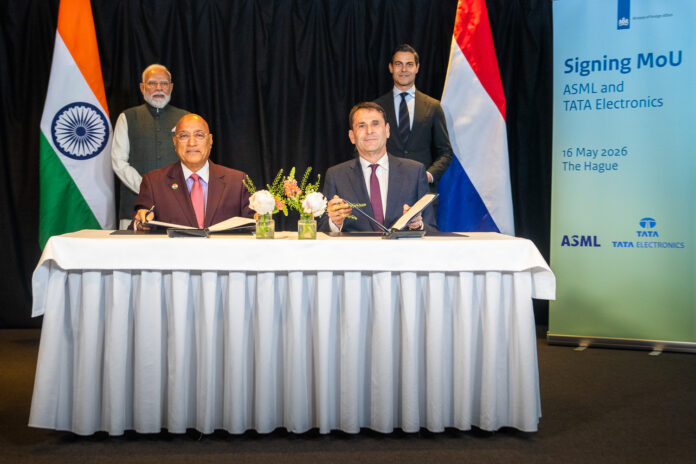
Tata Electronics and the Dutch company ASML have signed a Memorandum of Understanding to advance semiconductor manufacturing in India. Under the agreement, ASML will supply its full suite of advanced lithography tools and solutions to support the construction and production ramp-up of Tata Electronics’ upcoming semiconductor facility in Dholera, Gujarat. This collaboration aligns with growing strategic ties between India and the Netherlands in critical technology sectors.
Partnership in the semiconductor sector
The partnership will focus on deploying ASML’s industry-leading technologies to ensure seamless operations at the Dholera facility, which is India’s first commercial 300 mm silicon wafer fabrication plant. Beyond equipment supply, the two companies plan to build research and development infrastructure, accelerate training for local talent, and establish proactive supply chain resilience. Given the critical role of lithography in chip manufacturing, these initiatives are designed to support the project’s long-term success.
Dr Randhir Thakur, Chief Executive and Managing Director of Tata Electronics, expressed excitement about partnering with an industry leader known for global innovation. He stated that ASML’s deep expertise in holistic lithography solutions would ensure a timely production ramp-up in Dholera, create a resilient and trusted supply chain for global clients, drive innovation, and develop talent locally. He added that this foundational partnership brings a shared commitment to the highest standards of quality, yield, and manufacturing excellence.
Christophe Fouquet, President and Chief Executive of ASML, noted that India’s rapidly expanding semiconductor sector presents many compelling opportunities, and the company is committed to establishing long-term regional partnerships. He called the agreement an important milestone and stated that ASML looks forward to close collaboration with Tata Electronics and its broader ecosystem. He added that Tata Electronics is strongly positioned to expand its semiconductor capabilities, and that ASML is pleased and honoured to contribute its technical expertise while helping to nurture local talent.
Semiconductor fabrication plant
The Dholera fabrication plant represents a planned total investment of 11 billion USD. Once operational, it will produce chips for various global markets, including automotive, mobile devices, and artificial intelligence applications. Construction at the site is currently progressing rapidly. To support this journey, Tata Electronics has also strategically partnered with Taiwan’s Powerchip Semiconductor Manufacturing Corporation, granting it access to a broad technology portfolio ranging from 28nm, 40nm, 55nm, and 90nm to 110nm production nodes.
The availability of skilled domestic talent is critical to realising India’s vision of becoming a leading player in global manufacturing. Consequently, Tata Electronics has partnered with several leading international and Indian companies and institutions to empower young people locally with the necessary knowledge and skills.
Tata Electronics
Founded in 2020 as a new venture of the Tata Group, Tata Electronics operates across several Indian states, including Gujarat, Assam, Tamil Nadu, and Karnataka, as well as international offices in the US, Taiwan, and Singapore. The company offers integrated services across a trusted electronics and semiconductor value chain, including electronics manufacturing services, semiconductor assembly and testing, foundry capabilities, and design services. The company also commits to creating a socio-economic footprint by employing many women in its rapidly growing workforce. Furthermore, it actively supports local communities through environmental, education, healthcare, sports, and livelihood initiatives.
During Modi’s visit, the Netherlands and India also signed an agreement to strengthen cooperation between the countries in trade, security, water management, and new technology, among other areas. The agreement also includes more consultations between government leaders, ministers and senior officials of the two countries.
NEWS BRAINPORT