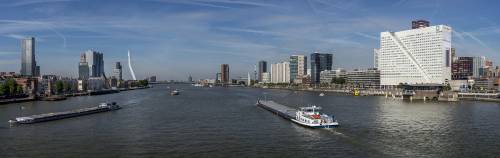
Drinking water companies that rely on the River Meuse for their water supply have once again urged the Dutch government to do more to protect water quality. The Association of River Water Companies (RIWA) says progress remains limited despite years of calls for stronger international cooperation and tighter controls on harmful discharges into the nearly 1,000-kilometre-long river.
“The urgency to take action on this is increasingly confirmed year after year,” RIWA director Maarten van der Ploeg said following the publication of RIWA-Maas’s 2025 annual report.
“It is not that nothing is happening, but we do lack a sense of urgency within the Dutch government. As a source of drinking water, the Meuse is under pressure from pollution and drought. We also have no control over direct and indirect discharges within the river basin.”
In its annual report, RIWA-Maas again calls for action. The organisation, which represents six Dutch and Belgian water companies supplying drinking water to around 7 million people, says governments and companies responsible for discharges must take greater responsibility. It is a message the association has repeated for years.
Van der Ploeg said the fragmented oversight system in the Netherlands remains a challenge.
“The difficult thing is that no single authority in the Netherlands is responsible for water quality. Many organisations have a role, including municipalities, provinces, water boards, environmental services and Rijkswaterstaat. One party must take the lead. In our view, the central government is unfortunately not doing this sufficiently.”
He said the Netherlands could learn from Flanders. “When we asked the Flemish government for specific information, we received it within a week. In the Netherlands, that is a lengthy process.”
Last year, water companies temporarily stopped drawing water from the Meuse 56 times because pollution levels were too high. As a result, water intake had to be halted on 61 occasions in 2024.
Van der Ploeg stressed that Dutch drinking water remains of the highest quality.
“The water from the tap is impeccable. Our drinking water is among the best in the world. But we do need a clean source. You do not want to rely on increasingly intensive purification processes to maintain water quality. We are seeing a rise in the number of chemical substances in river water that can be harmful even at low concentrations. Combined with increasing drought and lower river flows, this is a cause for concern.”
@anp | NEWS BRAINPORT